You are using an outdated browser. Please upgrade your browser to improve your experience and security.

Skip to main
Blog

Practicing Self-Care, Step-by-Step

BY: Trevor News
Donate

If you find yourself feeling exhausted, overwhelmed, or just “off,” you’re not alone. Everyone needs to take care of themselves, even if it’s just enjoying a quick snack or doing simple breathing exercises. Self-care is essential, but it can be challenging to make time for it. And if you struggle with your mental health, it can be even tougher to make self-care a part of your routine.

To make self-care a little easier, we made a guide that will take you step-by-step through different forms of self-care. You don’t have to follow it to the letter, but we hope this guide brings you comfort and reminds you to nourish your body and mind!
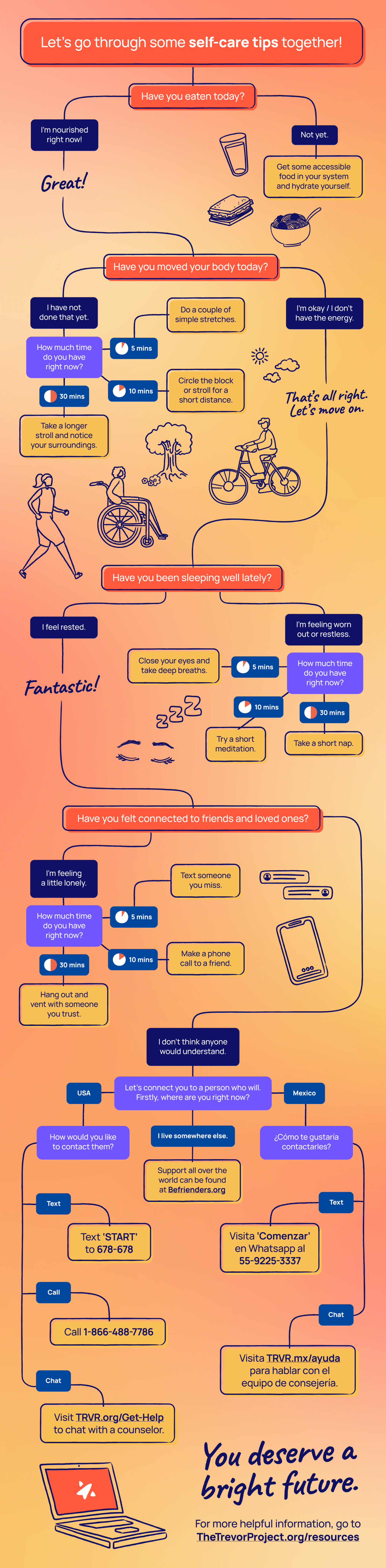

Flowchart that details step-by-step different techniques for emotional regulation and self-care, like preparing a small snack, taking a walk, and reaching out to The Trevor Project.

Read more from
Blog

Illustrations of Audre Lorde & Marsha P. Johnson
Blog

From Suffrage to Support: Expanding the Definition of Women’s Empowerment

For over a century, the fight for women’s rights has been marked by both remarkable progress and ongoing challenges. From the suffragists who fought for the right to vote to today’s advocates working for equal pay, reproductive rights, and greater representation, women’s history is a story of resilience, breaking barriers, and expanding opportunities for all.   As we reflect during Women’s History Month, it’s essential to recognize that empowerment is ever-evolving — and that growth must include celebrating and uplifting LGBTQ+ voices. Historically, women’s rights movements have often centered on the experiences of white, cisgender, heterosexual women, leaving LGBTQ+ women, nonbinary…
Photo of the blog's author, Leah Juliett.
Blog

Clinging to Hope: Honoring C-PTSD Awareness Day

Content Warning/Author’s Note: My story is rooted in my lived experience as a survivor of multiple forms of sexual violence and suicidal ideation. Everyone living with C-PTSD has an entirely different story. In reflecting on my personal narrative, I use “she/her” pronouns to describe my childhood self, but I currently use “they/them” pronouns to describe myself in the present and future tense. I remember the feeling of my childhood carpet on my back as I stared at the ceiling for hours. At fourteen years old, I scribbled manic notes in my journal about not wanting to be alive, and ate…